Thailand is one of the few places in the world where scuba divers might come face to face with the world’s biggest fish – the whale shark. My article for Fah Thai magazine describes this enigimatic but harmless aquatic giant
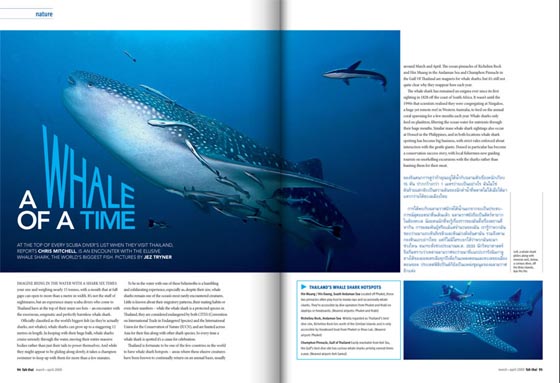
You can see a bigger version of this story, complete with Jez Tryner’s amazing whale shark photos, on p94 of the March issue of Fah Thai which you can browse online. If you’re interested in practical info on where to scuba dive with whale sharks in Thailand, see my previous post on Divehappy. Here’s the full text of the whale shark story:
A Whale Of A Time
Top of every scuba diver’s list when they visit Thailand is an encounter with the elusive whale shark, the world’s biggest fish. Chris Mitchell goes in search of the ultimate underwater encounter.
 Imagine being in the water with a shark six times your size and weighing nearly 15 tons, with a mouth that at full gape can open to over a metre in width. It’s not the stuff of nightmares but an experience many scuba divers who come to Thailand have at the top of their Must See lists – an encounter with the enormous, enigmatic and perfectly harmless whale shark, which can grow up to a staggering 12 metres in length and is officially classified as the world’s biggest fish. In keeping with their huge bulk, whale sharks cruise serenely through the water, moving their entire massive bodies rather than just their tails to power themselves – and while they look as if they move slowly, it takes a champion swimmer to keep up with a whale shark’s implacable progress for more than a few minutes.
To be in the water with one of these behemoths is a truly humbling and exhilarating experience, especially as, despite their size, whale sharks remain one of the ocean’s most rarely encountered creatures. Little is known about their migratory patterns, their mating habits, or even about their numbers – while the whale shark is a protected species in Thailand, they are considered endangered by both CITES and the International Union for the Conservation of Nature, and they are hunted across Asia for their fins along with other shark species. Therefore everytime a whale shark is spotted it’s a cause for celebration.
Thailand is fortunate to be one of the few countries in the world to have whale shark hotspots – areas where these elusive creatures have been known to continually return on an annual basis, usually around March and April. The ocean pinnacles of Richelieu Rock and Hin Muang in the Andaman Sea and Chumphon Pinnacle in the Gulf Of Thailand are magnets for whale sharks, but it’s still not quite clear why they reappear here each year.
The whale shark has remained an enigma ever since its first sighting in 1828 off the coast of South Africa. It wasn’t until the 1990s that scientists realized whale sharks were congregating at Ningaloo, a huge yet remote reef in Western Australia, to feed on the annual coral spawning for a few months each year. Whale sharks only feed on plankton, filtering the ocean water for nutrients through their huge mouths. Similar mass whale shark sightings occur at Donsol in the Philippines too and in both locations whale shark spotting has become big business with strict rules enforced about interaction with the gentle giants. Donsol in particular has become a conservation success story with local fisherman now guiding tourists to go snorkeling with whale sharks rather than hunting them for their meat.
While snorkeling with whale sharks is an undoubted thrill, there is nothing to rival the sheer luck of scuba diving at one of Thailand’s hot spots when a whale shark makes a serendipitous arrival. To be beside a whale shark as it comes to the surface to bask in the sunlight and investigate the curious bubblemaking creatures around it is an unforgettable experience. It’s also the sort of encounter that makes tourists become ardent amateur conservationists, and the EcoOcean Whale Shark Identification program has become one of the most popular initiatives to channel that interest.
By “crowd sourcing” underwater snaps of whale sharks taken by divers and snorkelers (whatever their level of ability with a camera), EcoOcean has cross referenced thousands of photos using technology originally developed by NASA to identify and track specific whale sharks thanks to their unique white dot markings. So far over 1300 whale sharks have been identified from all over the world by EcoOcean from over 14000 photos. The Phuket Marine Biological Centre and local dive operators have co-ordinated with EcoOcean to continue to send information to the central whale shark database. Every time a whale shark is positively identified, the original photographers are kept up to date, thus letting them keep in touch with the progress of their “own” whale shark.
Revelations about whale sharks are becoming more frequent thanks to this increased interest, the most recent discovery being that while whale sharks move slowly when at the surface and witnessed by humans, they subsequently dive to 1000 meters deep in a steep descent in search of food, ricocheting between the sunless depths and the shallows.
As more is learnt about the whale sharks, there is also more cause for concern – the relatively large amount of sightings and measurements from the last couple of decades indicate that the average size of the whale shark is shrinking, due to hunting and lack of time to reproduce. It’s through initiatives like Thailand’s protection of whale sharks within its own coastal waters and the EcoOcean identification database that greater awareness of the whale sharks’ movements, numbers and safety can be promoted – and it’s through this awareness that generations to come will be able to have their own encounters with the biggest fish in the world.
Snapping Sharks – How You Can Help Save The Whale Sharks
It’s easy to get an inexpensive underwater housing for a point and shoot digital camera these days, and the results can be remarkably good, especially when near the surface in the sunlight where the whale sharks like to bask.
EcoOcean requires photos of whale sharks that capture a specific part of the whale shark’s body – the part above the pectoral fin. Photographers must be careful to remain at least 3 metres away from the whale shark. See www.WhaleShark.org for more information of taking identification pictures of whale sharks
